
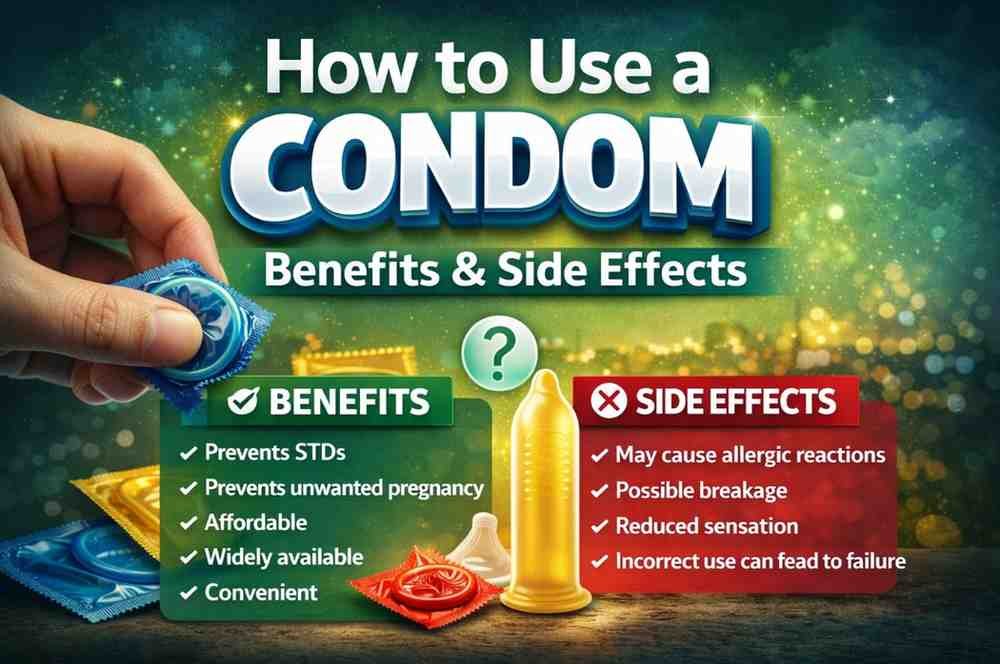
How to Use a Condom Benefits & Side Effects Explained
A condom is a thin, flexible barrier worn on the penis during sex to prevent pregnancy and reduce the risk of sexually transmitted infections (STIs). It works by stopping sperm from reaching the partner and blocking the exchange of fluids that carry infections. The male condom is the most widely used type worldwide. Most condoms are made from latex, though non-latex options like polyurethane and polyisoprene are available for people with latex allergies. Read more: Best Condom In Pakistan
Key Facts About use a Condom
- A condom acts as a physical barrier during sexual intercourse
- It is the only contraceptive that protects against both pregnancy and STIs
- Available in male and female versions
- Most commonly made from latex material
- No prescription required to purchase
Why Use Condoms? Reasons People Choose Condom Protection
Understanding why use condoms goes beyond basic birth control. Here are the most important reasons why people use condoms every day.
Top Reasons Why People Use Condom:
- Dual Protection: Condoms protect against both unwanted pregnancy and STIs at the same time. No other method offers this dual benefit.
- Hormone-Free: Unlike pills or injections, condoms do not affect the body’s natural hormonal balance or menstrual cycle.
- Immediately Effective: No waiting period. Use them whenever needed without any preparation.
- Widely Accessible: Available at pharmacies, supermarkets, and online stores without a prescription.
- Affordable: One of the most cost-effective contraceptive options available.
- No Long-Term Side Effects — Condoms do not affect future fertility or overall health.
Benefits of Condoms: Why They Are Recommended Worldwide
The benefits of condoms are well-documented by health organizations globally. Here is why they remain the top recommended protection method.
Health Benefits:
- Pregnancy Prevention: Up to 98% effective with perfect use
- STI Protection: Significantly reduces risk of HIV, chlamydia, gonorrhea, and syphilis
- Reduces HPV and Herpes Risk: Offers partial but meaningful protection against skin-contact infections
- No Hormonal Interference: Safe for people who cannot use hormonal contraceptives
Practical Benefits:
- Easy to carry and store
- Available in multiple sizes, textures, and materials
- Can be used alongside other contraceptive methods for added protection
- Instant effectiveness — no daily routine required
How to Use a Condom: Step-by-Step Condom Use Method
This is the most critical part of this guide. Learning how to put on a condom correctly ensures maximum protection every time. Follow this complete condom use karne ka tarika from start to finish.
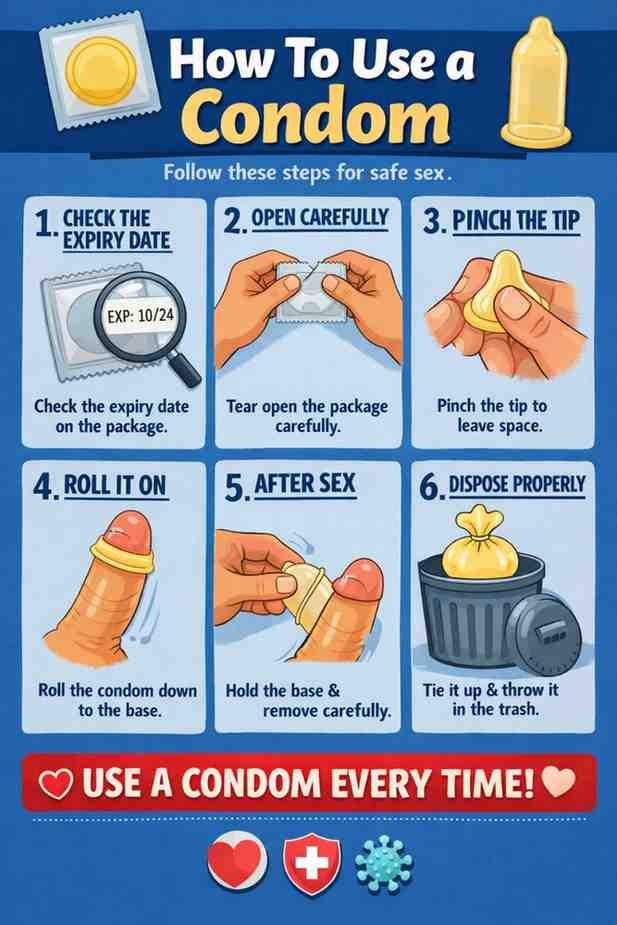
Step 1 Check the Packet Before Opening
- Look at the expiry date printed on the wrapper
- Press the packet gently to feel the air bubble inside
- No air bubble means the seal is broken discard and use a new one
- Never use an expired condom
Step 2 Open the Wrapper Carefully
- Tear from the notched edge using your fingers only
- Do not use teeth, scissors, or fingernails
- Any sharp contact risks damaging the condom inside
Step 3 Check the Correct Orientation
- The rolled rim should face outward
- It should unroll downward easily when placed correctly
- If it does not unroll, it is inside out — discard it and use a fresh one
- Never flip a condom after it has touched the penis
Step 4 Pinch the Tip
- Squeeze the reservoir tip at the top to remove all air
- This leaves space for semen after ejaculation
- Skipping this step is one of the most common causes of condom breakage
Step 5 Roll It Down the Penis
- Place the pinched condom at the head of the erect penis
- Roll it all the way down to the base
- Make sure there are no air pockets along the shaft
- The condom should sit snugly and flat against the skin
Step 6 Use the Right Lubricant
- Use water-based or silicone-based lubricant with latex condoms
- Never use oil-based products — coconut oil, petroleum jelly, baby oil, and body lotion all degrade latex
- Proper lubrication reduces friction and lowers the risk of tearing
- Non-latex condoms are compatible with oil-based lubricants — always check the label
Step 7 Withdraw Carefully After Sex
- After ejaculation, withdraw while the penis is still erect
- Hold the base of the condom firmly during withdrawal
- This prevents the condom from slipping off inside the partner
- Wrap the used condom in tissue and dispose of it in a bin
- Never flush a condom down the toilet
This is the complete guide on how to wear a condom properly and how to apply condom from beginning to end.
How to Apply Condom Properly: Common Mistakes to Avoid
Even people who regularly use condoms sometimes make errors. Here are the most common mistakes when learning how to apply condom properly.
Mistakes That Reduce Condom Effectiveness:
- Putting it on too late: The condom must go on before any genital contact, not just before ejaculation. Pre-ejaculatory fluid can carry both sperm and infections.
- Using the wrong size: A condom that is too tight may break. One that is too loose may slip off during sex.
- Not pinching the tip: Leaving air in the reservoir tip increases pressure and causes breakage.
- Using oil-based lubricants : These break down latex quickly and silently.
- Wearing two condoms: Double-layering increases friction between the two and makes both more likely to tear.
- Storing improperly: Wallets, car glove boxes, and back pockets expose condoms to heat and friction.
- Not checking the expiry date: Expired condoms are significantly weaker and less reliable.
How Effective Are Condoms? Real Numbers Explained
How effective are condoms depends entirely on how consistently and correctly they are used.
Condom Effectiveness Breakdown:
| Use Type | Effectiveness Against Pregnancy |
|---|---|
| Perfect Use (every time, correctly) | ~98% |
| Typical Use (real-world average) | ~85–87% |
STI Protection Effectiveness:
- Highly effective against HIV, chlamydia, gonorrhea, and syphilis
- Partially effective against herpes and HPV (skin-contact infections)
- Most effective when used from start to finish of every sexual encounter
The gap between perfect use and typical use is caused almost entirely by human error, not product failure.
Different Types of Condoms: Which One Is Right for You?
There are many different types of condoms available today. Choosing the right one improves both protection and comfort.
Types of Male Condoms:
- Latex Condom: The standard option. Widely available, affordable, and highly effective. Best used with water-based or silicone-based lubricants only.
- Non-Latex Condom: Made from polyurethane or polyisoprene. Ideal for people with latex allergies. Compatible with oil-based lubricants.
- Ultra-Thin Condom: Reduces sensation difference. Offers the same level of protection as standard condoms.
- Textured Condom: Ribbed or dotted design to increase sensation for one or both partners.
- Flavored Condom: Designed for oral sex only. Should not be used for vaginal or anal intercourse.
- Large / Snug Fit Condom: Sized for better fit and comfort. A properly fitting condom is safer and more comfortable.
Female Condom:
- Inserted into the vagina before sex
- Gives the receiving partner control over protection
- Compatible with all lubricant types
- Can be inserted up to 8 hours before sex
Using Condoms Side Effects: What to Expect
Condoms have very few side effects compared to hormonal contraceptives. Here is what you should know about using condoms side effects and timing condoms side effects.
Physical Side Effects:
- Latex Allergy: The most common issue. Symptoms include itching, redness, or swelling. Switching to a non-latex condom resolves this.
- Reduced Sensitivity: Some users report decreased sensation with standard-thickness condoms. Ultra-thin options significantly reduce this.
- Dryness or Irritation: Can occur without adequate lubrication. Adding a compatible lubricant resolves this easily.
Timing and Performance Side Effects:
- Some people feel the pause to apply the condom interrupts arousal or timing during sex
- Making the application part of foreplay reduces this concern
- No hormonal, systemic, or long-term physical side effects are associated with condom use
When NOT to Use a Condom
Knowing when not to use a condom is just as important as knowing how to use one.
Do Not Use a Condom If:
- It has expired. Check the date on every packet before use. Latex degrades over time.
- The packaging is damaged: If the wrapper is torn, punctured, or has no air bubble, the condom inside may already be compromised.
- It has been stored in a wallet or hot environment: Heat and friction weaken latex and damage the seal.
- It has already been used: Each condom is single-use only. Never reuse.
- You plan to use two at once: Double condoms increase friction and make both more likely to break.
- You are using oil-based lubricants with latex: This silently degrades the latex before or during use.
- It is a flavored condom for vaginal/anal sex: Flavoring agents can disrupt natural pH and cause irritation or infection.
Facts About Condoms and Pregnancy
These are the most important facts about condoms and pregnancy that every sexually active person should be aware of.
Key Facts:
- No contraceptive is 100% effective: Including condoms. A small failure rate exists even with perfect use.
- Emergency contraception is an option: If a condom breaks or slips, emergency contraception can be taken within 72 hours. The sooner, the more effective.
- Condoms do not affect future fertility: Long-term condom use has no impact on the ability to conceive later.
- Oil-based products cause silent failure: A condom can be degraded by oil without any visible sign of damage.
- Condoms are safe from the very first use: No adjustment period or preparation is needed.
- Condom sex is safer sex: Using a condom on the penis during every sexual encounter is the most reliable non-prescription protection available.
Frequently Asked Questions (FAQ)
Q1: Can I use a condom with other contraceptives?
Yes. Using a condom alongside hormonal contraceptives like the pill adds a second layer of protection against both pregnancy and STIs. This is often called the “double Dutch” method.
Q2: What size condom should I use?
Condoms come in snug, standard, and large sizes. A properly fitting condom is safer and more comfortable. If standard condoms feel too tight or too loose, try a different size or brand.
Q3: Does sex using condom feel different?
Some reduction in sensation is normal, particularly with thicker condoms. Ultra-thin options and adequate lubrication minimize this difference significantly. Most people adjust quickly with regular use.
Q4: How should condoms be stored properly?
- Store at room temperature away from direct sunlight
- Keep away from sharp objects and heat sources
- A bedside drawer is ideal
- Avoid wallets, car compartments, or back pockets
Q5: Are condoms effective against all STIs?
Condoms are highly effective against fluid-transmitted infections like HIV, chlamydia, and gonorrhea. For skin-contact infections like herpes and HPV, they reduce risk significantly but do not eliminate it entirely since they do not cover all exposed genital skin.
Q6: What is the condom use method for anal sex?
The same steps apply. Use a condom from the very beginning, apply a generous amount of water-based or silicone-based lubricant, and change the condom if switching between different types of sexual activity.
Final Word
Learning how to use a condom correctly is a fundamental part of sexual health. The steps are straightforward, but each one genuinely matters. Use them every time, check the expiry date, store them properly, and apply them before any genital contact begins.